

Virtual - Reality: A Preliminary Forensic Assessment Relating to Child Pornography in the Prosecutorial/Defense Effort
 Download PDF
Dr. Robert DeYoung
St. Thomas University
Forensic Recovery, LLC
Davie, FL 33331-2964
rdeyoung@forensicrecovery.com
Abstract
The US Supreme Court recently held that sections of the Child Pornography Prevention Act were overly broad and unconstitutional. Prosecutors protested, saying that the decision would severely hamper prosecutorial efforts. Defense attorneys proposed the decision would create the perfect defense. This article undertakes an initial, yet limited, glimpse into the forensic implications of the US Supreme Court decision deeming virtually created child pornography, in that no victim exists (an undeniable element of the federal and state statutes). As remarkable as the technological advances are today, there exist limitations that allow one to identify differences between “virtual” and “real” child pornography. The capabilities and limitations of software, hardware and the user should be considered in an assessment to determine virtuality or reality. With even moderate to high levels of technical proficiency in graphic manipulation, today’s end-users generally fail to adequately generate a virtual person that is indistinguishable from a real person. This study provides preliminary findings through the forensic examination of virtual and real imagery that may facilitate the forensic determination.
On April 16, 2002, the Supreme Court of the United States, in Ashcroft, Attorney General, et al. v. Free Speech Coalition et al., held that particular sections of the Child Pornography Prevention Act (CPAA) prohibitions of §§ 2256(8)(B) and 2256(8)(D) were overly broad, and therefore unconstitutional. The particular section in question imposed severe penalties upon individuals who generated or possessed computer file images or pictures that merely appeared to depict child pornography. While it is certainly unusual for organizations to come to the defense of child pornography with the potential for sexual exploitation of children, opponents of the section argue that the real issues at hand are free speech and technology. This approach has some legitimacy in that the entertainment, art and publishing communities could suffer. One does not need to look far to find examples of films, books, or plays that would violate the CPAA. Romeo and Juliet, American Beauty, Blue Lagoon and Lolita portray sexual activity among individuals under the age of 18. The impact on producers, actors, actresses and authors could be frightening and unsettling (Lyman, 2001; Karp, 2002).
The Free Speech Coalition also argued that there is no sexual exploitation of a child if the child is a virtual creation. The position of the Free Speech Coalition is that if one does not use a child, then there is not a victim. Free Speech Coalition attorney Louis Sirkin stated, “In virtual reality, there is no person, so there is no injured party” (Karp, 2002). In 1999, the United States Court of Appeals for the Ninth Circuit, in San Francisco, ruled in favor of the Free Speech Coalition. The Appellate Court held that the prohibition of virtual child pornography did indeed violate the free speech guarantee of the First Amendment. The stage was now set, bringing the subject of virtual images (technology implications) and child pornography (free speech implications) to the table (Lyman, 2001).
Prosecutors vehemently protested that prosecutorial efforts would be severely limited, and law enforcement agencies placed at a serious disadvantage in the effort to eliminate child pornography. Attorney General John Ashcroft noted that the recent US Supreme Court decision created “a dangerous window of opportunity for child abusers” (Stout, 2002). Criminal defense attorneys immediately saw an avenue by which cases could be successfully defended by the mere fact that virtual child pornography had no victim, a clear element of traditional child pornography laws. Yet, even with the advancement of computer technology, the Supreme Court decision yields more questions than answers. Are the prosecutorial concerns valid? Have the courts shaped the perfect defense to production, distribution and possession of child pornography? From a forensic assessment, the answer to both questions is, in all probability, no.
Technological Capabilities and Limitations
As remarkable as the technological advances are today, there exist limitations that clearly allow one to identify the differences between “virtual” and “real” child pornography. In an effort to better understand how technology can impact the exploitation of children, one must understand the capabilities and limitations of technology as it relates to the replication and manipulation of electronically stored computer file images that ultimately are displayed on a computer monitor or transferred to print format. Prior to any assessment as to the realism that virtual software/hardware combinations are capable of producing, one must be familiar with the capabilities and limitations of computer software and computer hardware. These two components, in combination, are critical to the level at which virtual imagery replicates actual imagery.
There are four areas where imagery manipulation through the use of software might occur: (1) animation software, (2) 3-D software, (3) morphing software, and (4) altered images. There are a multitude of virtual graphics companies that provide commercially available software capable of imagery manipulation. The software is available to users with limited visual graphic backgrounds as well as to those well versed in imagery manipulation. Animation software is the placement of a series of images used together to create the illusion of animated images, as is typically seen in a video or movie clip. 3-D software provides a simulated depth to images, thereby rendering a more life-like appearance. Morphing software electronically allows two or more images to change into each other. Altered images permit the inclusion of parts of one image to be inserted into a second image, generating a completely different image than was originally produced (http://www.3dpromo.com/effects.htm, 2002). Using graphic software programs such as these, alone or in combination, produce dramatic results. Yet there is still little question in one’s mind that the imagery is manipulated and virtually produced.
Hardware is another issue that can become a limiting factor in the way that virtual imagery replicates actual imagery. Home and business computer systems lack the processing power to blur the distinction between virtuality and reality. One need only look to the entertainment industry to find state-of-the-art equipment to generate virtual movies. To date, the standard to which virtual reality is held can be seen in Columbia Pictures’ (2001) Final Fantasy: The Spirits Within. As impressive as the film is, one would have little difficulty in making the determination that the “actors” are not real, regardless of whether viewing the virtual characters in full animation or still frames (see Figure 1).
Figure 1. Computer generated images of virtual characters from Final Fantasy: The Spirits Within.
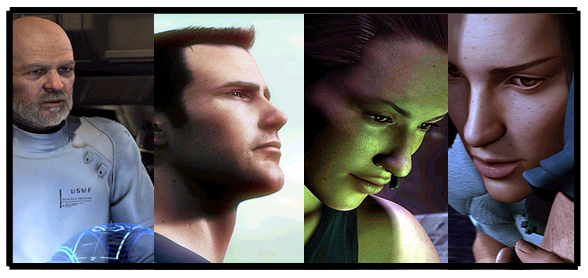
The level of technical talent, supported by state-of-the-art equipment not typically found in homes or businesses, is imperative to the development of such an impressive replication. The Web site describes how the imagery was virtually generated from the conceptual visions of the design team: As the first HyperReal computer-generated feature film, Final Fantasy: The Spirits Within was based entirely on original designs by a team of gifted conceptual artists. No real locations, people, vehicles or props were used. Everything was crafted from the imaginations of the artists who drew inspiration from paintings, magazines, books and photographs to turn the director’s vision into reality (http://www.finalfantasy.com, 2001).
The Forensic Assessment
From a forensic perspective, it can be difficult to differentiate between a virtual image and a real image when assessing still computer-file images. Many variables determine the quality of an image, virtual or real. Resolution, lighting and prior manipulation of the image are just a few factors that can significantly affect the forensic assessment. A manipulated image will likely alter the original image, sometimes creating a blurring or smoothing effect, as well as a loss of detail.
Forensically, the images can be viewed graphically in two formats: (1) Standard View and (2) Zoom-In View. The Standard View affords an initial assessment of the overall image. This permits the examiner to evaluate the image in relation to known reality images. In contrast, the Zoom-In View allows the examiner to zoom in on the image to a level of five times (or more) the normal viewing power. This allows a closer examination on a pixel-by-pixel basis. In assessing still computer-file images in Standard View, one must use caution in attempting to determine virtuality or reality. The imagery below displays the relative likeness between virtual and real images in Standard View (see Figure 2 and Table 1).
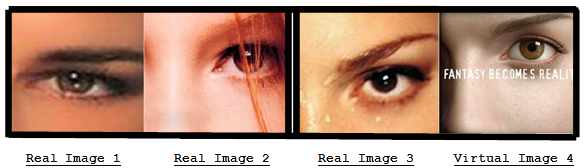
Figure 2. Standard view computer-file images cropped to the same dimensions. Note the clarity in the single virtual image (far right).
Table 1. Detailed Image Information from Figure 2
| RealImage1 | RealImage2 | RealImage3 | VirtualImage4 | |
| File Type | JPEG | JPEG | JPEG | JPEG |
| Dimensions | 268x242 | 273x240 | 268x245 | 267x245 |
| Pixels/Inch | 70 | 300 | 300 | 72 |
| Pixel Depth/Colors | 24/16 M | 24/16 M | 24/16 M | 24/16 M |
| Modified | No | No | No | No |
| No. of Layers | 1 | 1 | 1 | 1 |
| No. of Alphas | 0 | 0 | 0 | 0 |
Interestingly, the virtual image usually appears more focused and detailed in the Zoom-In View when compared to an image of a real individual. Zooming in at a higher power, the examiner will note that images of real individuals will lose focus at a higher rate than images of virtual individuals (see Figure 3). This phenomenon may well be the key in forensically assessing virtual versus real imagery. Close inspection shows that images of real individuals (Figure 3, Images 1-3), examined at a level five times greater than the normal view, display a pronounced loss of detail. Yet, the virtual image (Figure 3, Image 4), even examined at a level five times greater than the normal view, shows minimal loss in detail. This assessment applies when one is merely examining a single image to establish a determination of reality or virtuality. The same process can be used when addressing software manipulations of animation, 3-D, and morphing, as these techniques utilize multiple occurrences of single images to create the desired effect. Altered images, those that permit the inclusion of parts of one image to be inserted into a second image and generating a completely different image than was originally produced, create a unique set of issues that only well-written legislation can address. An example of an altered image includes the electronic insertion of a real individual into a second image that ultimately portrays
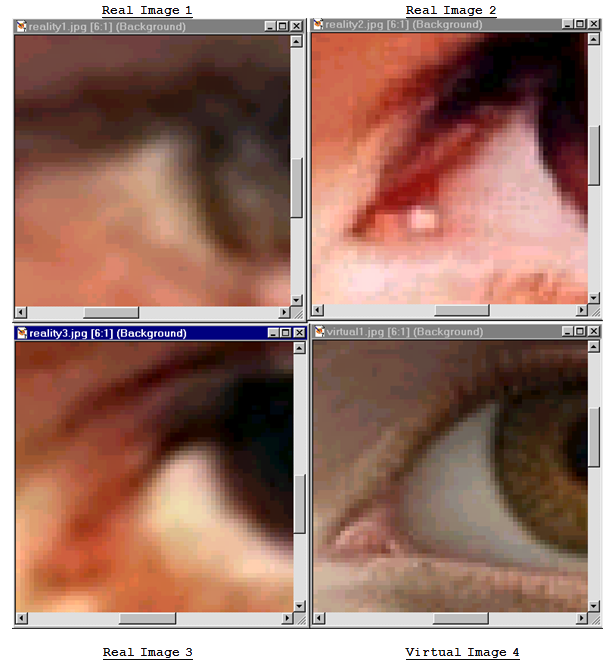
Figure 3. Zoom-In View of computer file images increased to a level of 5 times the normal viewing power. Note the clarity in the single virtual image (bottom right).
that individual in a dissimilar or unusual circumstance (PhotoFun, Inc., 2002). In most cases, altered images are easy to detect. Admittedly, the meticulous utilization of processes readily available in commercially obtainable software can diminish the ability to accurately detect an altered image. Close examination of the image in question, viewed at high power, may facilitate the identification of most electronically altered images.

Figure 4. Altered image.
Yet, some images are known to be altered only because the individuals depicted in the images appear in other images as well. The forensic examiner, through the exposure to hundreds of thousands of electronic images, creates a cognitive database from which altered images can be identified.
Conclusion
In that the capabilities and limitations of software, hardware, and the user must be considered in an assessment to determine virtuality or reality, it is undeniable that possessing even moderate to high levels of technical proficiency in graphic manipulation generally fail to adequately provide an end-user the ability to generate a virtual person that is indistinguishable from a real person. With this fact established, other relevant issues must bear questioning.
In spite of the Supreme Court’s decision that held that particular sections of the Child Pornography Prevention Act (CPAA) prohibitions of §§ 2256(8)(B) and 2256(8)(D) were overly broad, and therefore unconstitutional, the Court did not attempt to define “virtual” as it applied to child pornography. According to Jefferson Stebbins (2002), “Technology has blurred the line between actual reality and virtual reality to the extent that we often cannot distinguish between the real and the simulated.” Obviously, the forensic assessment focuses on the technical aspects of the images themselves, in the attempt to determine virtuality from reality. Yet few would argue the need to create a clear definition of the term “virtual” so that prosecutorial and defense efforts can move forward in their attempts to create a safe environment, free of exploitation, for the nation’s children. Only then can the forensic assessment of computer-imagery files be conducted as it was intended: absent prejudice and bias, and from a scientific perspective.
The legal and corporate communities must prepare for the inevitable future, when software and hardware advances develop to a level that virtuality is indistinguishable from reality, regardless of end-user capabilities or limitations. Legislation must align itself with societal expectations to confront the unlawful application of child exploitation by the use of technology.
This report provides a limited look into the forensic possibilities in conducting an assessment as to data sources relevant to the implications of technology on child pornography. The need for further research to assess the forensic similarities and differences between altered, virtual, and real images is apparent. Research would provide forensic verification sufficient to provide scientific evidence as to alteration v. virtuality v. reality. Further, collaborative networking among forensic examiners may create a significant database of analytic data from which valuable supportive evidence may be drawn.
The challenge comes in the very near future with the rapid growth and development of replication software that will ultimately blur the lines beyond current forensic capabilities. When that time arrives, it will be imperative that this country’s legislative bodies and court systems provide a clear, detailed, and well-defined legal definition of the terms “virtual” and “reality.”
References
Columbia Pictures Corporation. Final Fantasy: The Spirits Within (2001). Chris Lee Productions, Directed by Hironobu Sakaguci. Retrieved October 22, 2003 from http://www.finalfantasy-spiritwithin.com.
Final Fantasy: The Spirits Within (2001). Retrieved October 22, 2003 from http://www.finalfantasy-spiritwithin.com/www/main.htm.
Herald Staff (2002, April 22). Free speech on the internet;
court rules on child-porn case. Miami Herald, p 6B.
Karp, J. (2002, January 22). Virtually illegal: Is
computer-generated child porn really child porn? Retrieved February 22, 2003 from TechTV at http://www.techtv.com/cybercrime/digitaldisputes/story/0,23008,3322163,00.html
Lyman, J. (2001). U.S. Supreme court to examine virtual
child porn law. NewsFactor Network. Retrieved February 25, 2003 from NewFactor Network at www.newsfactors.com.
PhotoFun, Inc. (2002). Personalized posters. Retrieved
April 11, 2003 from www.photofun.co.uk.
Stebbins, J. (2002, April 20). Court is right, but threat
still real. Palm Beach Post (FL), p 12A.
Stout, D. (2002, May 2). Attacking court, Ashcroft pushes
for new child porn bill. New York Times Service, p. 15A.
Supreme Court of the United States (2002). Ashcroft,
Attorney General et al. v. Free Speech Coalition et al.;
No.00-795. Retrieved October 22, 2003 from http://www.cdt.org/speech/020416cppa.pdf. Argued October 30, 2001 – Decided April 16, 2002.
Virtual Design, Inc. (2002). Animation, flip, 3d and morph
lenticular effects from virtual graphics. Retrieved
April 15, 2003 from http://www.3dpromo.com.
Professional Vitae
Dr. Robert DeYoung is the Master’s in Management Program Coordinator and an Assistant Professor in the Department of Management at St. Thomas University, teaching across a spectrum of graduate-level managerial and research curriculum. He completed his Master’s degree (MSM) at St. Thomas University, with a specialization in Human Resource Management and continued his studies, receiving a PhD in Educational Leadership from Lynn University in Boca Raton, Florida. Dr. DeYoung completed his doctoral dissertation, a naturalistic inquiry into the differences in coping strategies among parents of murdered, abducted, or long-term missing children.
Dr. DeYoung is retired from the Broward County Sheriff’s Office in Fort Lauderdale, Florida. He was responsible for originating the Law Enforcement Against Child Harm (LEACH) Task Force, a federally funded, nationally recognized task force that combats Internet crimes against children. Recognized as an expert in the field of Internet crimes against children, Dr. DeYoung holds Advanced Computer Forensic Examination certifications and Advanced Computer Crimes Investigator’s certification. He has instructed nationally on numerous topics related to law enforcement and management.
Dr. DeYoung is a member of the Decision Science Institute, the Southern Management Association, and the Southern Criminal Justice Association. Dr. DeYoung owns Forensic Recovery, a South Florida-based corporation providing expert computer forensic processes to the legal and corporate communities.
Dr. DeYoung owns Forensic Recovery, LLC, a corporation offering the legal and corporate communities computer forensic processes, including the collection, preservation, analysis, and presentation of electronic evidence in criminal investigations and civil litigations.


Common Case Scenarios
 Intellectual Property TheftAn employee or executive leaves an employer to start a new company or work for a competitor. The previous employer ends up in a legal dispute because the employee took with him client contacts, confidential trade secrets and intellectual property, or left a backdoor for remote access to the network at a later time. We can help determine how the employee acted prior to leaving the company or at the onset of litigation.
- Child Pornography Charges (Peer-to-Peer))
Internet Crimes Against Children (ICAC) task forces around the country identify and arrest potential traders of child pornography on a regular basis. We can review the Government's findings and conduct an independent examination of the digital evidence in order to determine the circumstances surrounding the charged files. - Divorce
Forensic Recovery can assist counsel in helping to identify, preserve and analyze digital evidence in family litigation. Often, our work is related to location data, communications, and hidden asset leads. Working through counsel on these matters is the preferred mechanism.